

So.. you’ve decided to join the band
(God save your soul)
Written by Jasel ’28 DEIC WM
Keep in mind that this is meant to be a brief introduction to band events so you can get settled into your first gig. For more extensive information on band lore, please refer to the Wikipedia page.
Additionally, please check out our pamphlet and website for an even briefer explanation of who we are and what we do.
Check us out on Instagram, TikTok, Facebook, YouTube, and X
Finally, while attendance is NOT mandatory in any way, shape, or form, we require a blood promise and at least 25% of your soul to be a part of the band.
1. The Officers
To see the names and faces of our current officers, click here.
On the Discord, officers have their position abbreviated by a letter next to their name (the x’s symbolize positions bandies have held in the past)
President (P)
Our “esteemed” president runs town halls (which you should go to) and basically handles administrative stuff. They are legally obligated (as stated in the constitution) to end every single band meeting with “Let’s Go Band Team!” Traditionally, the president does not wear a boater and wears a plaid kilt.
Drum Major (DrM)
The silly person wearing white with the mace. They schedule all our gigs and will hunt you down if you do not pull up.
Head Manager (HM)
Basically the band’s travel agent + personal stylist, also known as Mom. Organizes trips, feeds you, and makes sure you don’t wear the uniform backwards. Please see them if you have any questions related to the uniform or food during gigs.
Treasurer (T)
The money goblin known as Dad. They approve band purchases, and occasionally says “no” to sweet treats. If you would like to buy merch, please contact them.
Student Conductor (SC)
Makes sure the band is vaguely in tune. They also wear a white uniform.
Drillmasters (4 of them!) (DM)
They run our social events and also make sure instruments get to us during gigs. If you need anything for your instrument, you should look for your section leader. The sections are Garbussion (percussion and garb), Tubonerphones (Low brass), Flumpets (Flutes and Trumpets), and Saxinets (Saxophones and Clarinates).
Librarians (2 of them!) (LL, for luscious libe)
Yell “LIBE!” and one will magically spawn next to you with your music in hand.
Alumni Coordinator (AC)
Plans reunions, maintains the social media, and remembers everything that’s ever happened, ever as the band’s living history book. If you have any ideas for TikTok’s or Instagram stories, they are open to hear them!
Diversity, Equity, and Inclusion Coordinator (DEIC)
Listens when things aren’t okay, and makes sure the band is a welcoming, inclusive, and respectful space. Please see them if you have any concerns or questions.
We pie our officers in the face during their birthday so stay tuned for that!
2. The Uniform
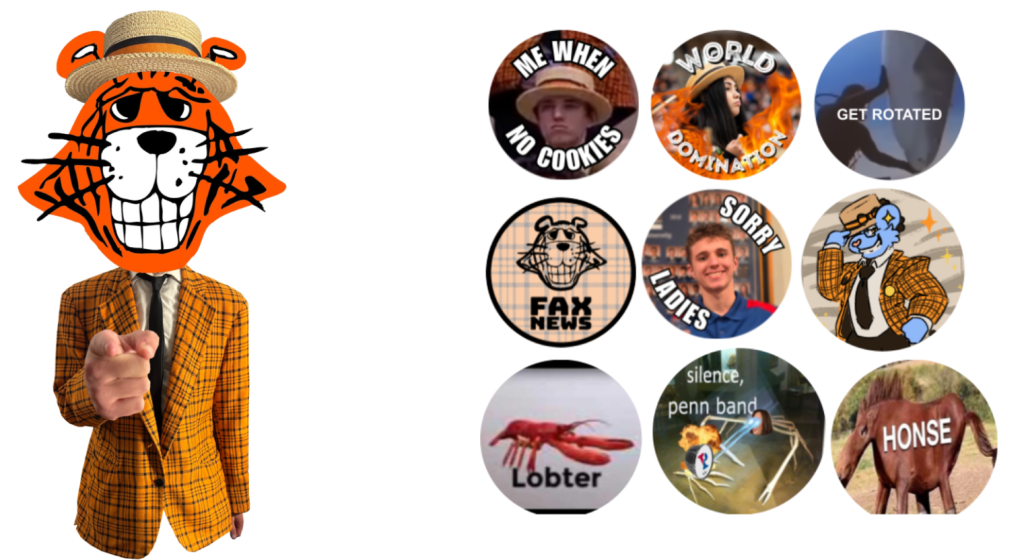
We are incredibly fashionable. Our uniform consists of:
- Plaid blazer (iconic and timeless)
- Boater (also iconic and timeless)
- White, button-down shirt with a collar
- Black dress pants
- Black tie
- White Shoes
Pins and hat accessories are totally fine! In fact, we have pin making socials so stay tuned for those. For more serious gigs, you may be required to take them off, yet this is rare.
You can keep your uniform for the year after three gigs. If you want to keep your hat, you can buy it as a senior.
Keep in mind that the full uniform is not always required either. The HM will let you know what to wear 🙂
Requesting a Uniform
The HM will happily give you your plaid and boater. Feel free to request other uniform parts as well, though these are subject to availability. For your first three gigs, you will be asked to return your uniform afterwards, however, after this it is yours to keep until the end of the academic year. If you want to be extra nice to mom, you should avoid asking for a uniform 5 minutes before important gigs, such as major away gigs. You can avoid stressing them out by either getting there early when you need something or meeting up with them beforehand.
Upkeep:
- Keep it clean(ish). Wash things, especially after sweaty gigs. DO NOT wash the plaid, the fabric is incredibly delicate and will bleed orange… so if it REALLY needs cleaning, ask our HM.
- If you lose the plaid or the boater, you lose your soul. Seriously, they are really expensive 😦
- Return what’s not yours. Uniform parts loaned to you by the Band must be returned at the end of the academic year (see HM instructions on the Discord when the time comes)
- If something rips, breaks, or melts (??), tell the HM.
3. The Armory
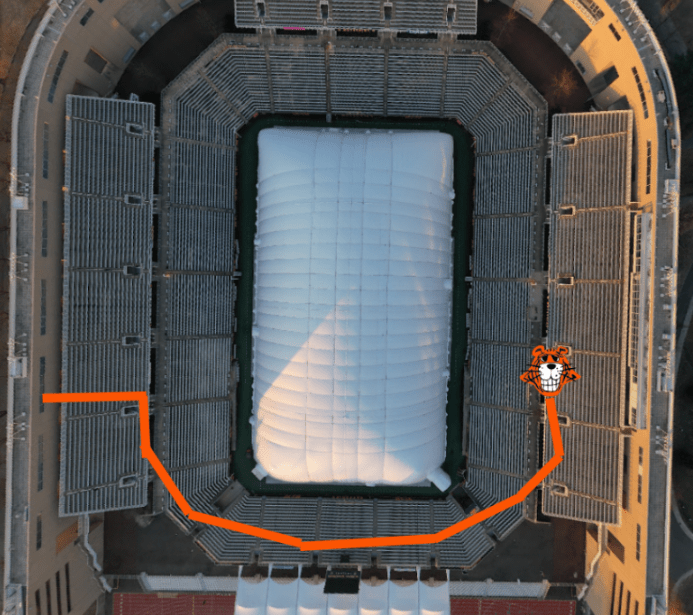
This is where we keep all our instruments and where we will be meeting up most of the time before gigs. It is located in Princeton Stadium behind Sections 30-31. Bandies are very easy to spot so you will most likely be able to follow someone there. The Upper Armory, where we keep uniforms and merch, is up the stairs and a little bit further down to the left.
4. March Arounds
This type of gig is super fun and chill. We basically go to various locations on campus, usually the dining halls, and play for everyone that is there.
Here are some occasions where we do this:
- Before football games to raise school spirit
- Valentine’s Day
- We take song requests from our repertoire
- Mardi Gras
- We have played in dining halls and thrown beads at people in the past
- Dean’s Date Eve and Dean’s Date
- If this still exists by the time you are reading this lol
- We play at various libraries while they are packed with people working on their essays
- We also play during the University’s dean’s date celebration and often get free merch doing this without waiting in line
- April Fools
- Basically dress as silly as possible and be as silly as possible
- Holidays
- We play Christmas and Hanukkah songs in the dining halls
5. Football Games
Officers are super busy running around during football games, so here is a break down of what to expect before your first game
Arch Gig
After the March Around, we take our plaid and boaters off and dance under Bloomberg Arch. Unless you play Garbussion, in which case you play the various cadences we dance to.
Shows
For football games, we have a show before the game starts and during half time. Unfortunately, this means that we have an extra rehearsal on Thursdays to practice beforehand. We have an announcer read a silly script and make silly little formations based on what they say. Unlike traditional marching bands, we are a scramble band, meaning that we scramble into our formations, so don’t be too hard on yourself if it’s not perfect. If you like sweet treats, consider going to strugglebuses on Sunday and partake in show writing.
Third-Quarter
We take our pants off to reveal the band boxers. Ask Mommy or Daddy for a pair of these if you want – otherwise, wear any shorts (or regular pants, we don’t judge). Make sure to always steal the conductor’s pants at all costs. We don’t play in third, just do chants.
Fountain Gigs
If we win the football game, we play in the SPIA fountain! This is a really fun tradition. Unless it’s winter. Then it’s less fun. Here, we play Rock Lobster, which is a song where we all slowly sink to the ground at the descending part until we kick our feet in the air (lobstering)
Nassau Hall
During the last game of the season, we play inside Nassau Hall and say goodbye to our current officers, who have finished serving their terms. This is a great opportunity to see the inside since no students are allowed in there under ordinary circumstances. Of course, this means DON’T DO ANYTHING STUPID and DO NOT TAKE ANYTHING. This is a privilege given to us by the University, so please don’t incentivize them to take it away.
Food
If you miss a meal because of a gig, meaning that no dining halls are open because you were with us, the HM will feed you. Look out for their food form in the Discord. Keep in mind that because football games are hectic sometimes, you may be required to eat super fast.
Other Football Traditions and Chants
- We make the Drum Major drink a “7-8” (a disgusting concoction) before we go on the field
- Making people nervous means to gather up close to them
- We tackle the drum major during field rehearsals (with consent)
- There are armory gigs after field rehearsals, often “Rock Lobster”
- If we beat Harvard and Yale we play at the bonfire

6. Basketball Games
Luckily, Basketball Games are far more chill than football games. Still, here are a few things to know.
Heckles
The good thing about being indoors is that our heckles can actually be heard! We have many chants that are in the Heckles channel on the Discord so make sure you check those out. Free throws are a good opportunity to let out all your frustrations and scream your heart out as well!
Traditions
- We shout “How. much. Time. is. left. “ at 1:05, 1:04, 1:03, 1:02, 1:01 during the 4th quarter/2nd half and then “Thank you” after the announcer says “1 minute remaining in the ____”
- We wiggle our fingers for our free throws. i=If we make it/both, we say “you’re so good to me” “and my ax, and my cows, and my ancestor’s cows, etc”
- We also play Rock Lobster after we win Basketball games
Play-time
Unfortunately, we do not usually do shows during basketball season. We do, however, play during the game. Keep in mind that Athletics can be weird when we play, so keep your eye on the SC and DrM as they can stop you at any moment. It is really important that you stop when they tell you to or Athletics gets angy 😦
Ivies and March Madness
If our men’s and/or women’s do well enough, we get to travel with them to play at Ivy Tournament and NCAAs. We can take about 30 people based on instrumentation and attendance. Best and biggest trips of the year! You will have excused absences from class and in past years Athletics has even offered proctors for exams. It is really fun and the highlight of many people’s band experience. See the next section for more information 🙂
7. Away Gigs
Do NOT do anything stupid!!! Or else the president WILL burn you at the stake. You represent the band, and we are funding your travel, so please please PLEASE don’t make us look bad. Even though we don’t take ourselves seriously 99% of the time, this is part of the 1% we have to lock in. Believe it or not, we are an institution first and foremost.
Anyways, disclaimer aside, here is what you should expect:
Trip details
Most trips will be on the same day by bus, so you will know all the relevant information a week ahead of time. Others, such as Ivies or March Madness are several days long and by plane. Unfortunately, Athletics handles the logistics for these trips and does not tell us stuff with a lot of anticipation. It may be the case where we are told hours before we travel where and when we are going somewhere. Keep in mind that these trips are incredibly rare, and although they might sound intimidating on paper they are INCREDIBLY fun and I highly recommend you go! It is truly a once in a lifetime experience.
Call time
Please be where you need to be on time during travel to avoid inconveniencing other bandies. Sometimes these trips are literally out of our control and you may get left behind if you are not on time.
Packing (during long trips)
Stolen from Natasha ’24 xPxTxDM – also not a definitive list, bring what you will need!
- Clothes for as long as the trip lasts (maybe a day extra)
- Any schoolwork you want to get done
- Downtime activities (coloring, knitting/crocheting, puzzle books, handheld games, cards, etc)
- Your uniform – The Band travels in full uniform! Do not pack this away
- Charging cords/power banks
- Toiletries
- Be aware that you will need a real, Govt ID for March Madness
Singing
On our way to and from away games, we have the tradition of singing Princeton Songs and Band original songs.
Rooms
Room assignments are sent weeks before trips and there is a form the HM sends out so you can tell them about your roommate preferences and other relevant information for the trip. ODUS accommodations apply to trips sponsored by Athletics, so please let the DEIC know if these are not respected. Unfortunately, there are times where other bands host us and we may not be able to guarantee accommodations in these instances, but the HM and DEIC will still do their best to accommodate you!
8. Reunions
Housing
The University will provide housing for free during dead week and reunions. This may mean that you will be moved to another room and get randomly assigned roommates for this week.
After 5pm, there will be p-safe officers at every tent that will be giving you a hard time when going back to your dorm after that hour. Sorry 😦
Please keep in mind that the University is supposed to continue to provide approved accommodations for this period, so please contact the DEI Coordinator if they are not being provided. In exchange for this, the University requires you to do a small task.
If you are receiving housing through us, DO NOT miss your task under any circumstance, as this limits our ability to provide housing in the future and may get us fined. If you ABSOLUTELY under no circumstance able make it to your task, PLEASE LET SOMEONE KNOW BEFOREHAND and don’t just disappear as this allows us to get someone to replace you in time so we don’t face the consequences.
Food
The band will feed you during dead week and reunions. Bandies can sign up to cook for others during dead week. Please keep in mind that you are responsible for feeding any guests you may have. This is because it gives those who are cooking more work and puts a financial strain on the band.
Dead week
Reunions occur about a week after finals. The time period in between is known as dead week, where our wonderful DM’s prepare fun activities for us.
Alumni BBQ
This is usually one of the first events we have during reunions. We don’t play at the BBQ, just enjoy the DM’s cooking!
Alumni Archgig
This is a just like a regular archgig, but with way more people. We play under Bloomberg Arch as per usual. However, for this gig and this gig only, alumni have priority for Garb.
Alumni Jam Session
After the Archgig, we gather by Whitman and play songs with Alumns. Here, past SCs and DrMs lead each song from oldest to newest serving.
Fred Fox
This is our most serious gig. We take off our buttons and hat accessories for this and full uniform must be followed perfectly. Here we actually have to be coordinated (ew) and sound good (impossible), so trust that rehearsals leading up to this are as required as they can be given that we require no commitment.
P-Rade
We lead the P-rade, so this means going up and down Washington about five times, so choose your instrumentation wisely! You do have the opportunity to leave your instrument with a DM or switch with someone else if you get tired after each passing.
Other Things to Keep in Mind
- Alumns can be weird, so if anyone makes you uncomfortable, please let the DEI Coordinator know immediately.
- While you don’t have to go to dead week activities, YOU MUST GO TO OFFICIAL GIGS if you are receiving housing through us.
9. Two Ball
This section was originally authored by Ashley Prescott, with much assistance from Brad Friedman.
The game of two-ball has been adopted and popularized by the Princeton
Band to the point that people outside of Princeton seem to think it was born here. Though the Band has certainly invented many things, two-ball is
actually not one of them. I’m not sure where it was born, who created it, or what it was even called in the beginning. However, I do know that it’s about fifty times more entertaining than pool, whether you’re watching it or playing it.
What you need
Two-ball can be played with anywhere from two to ten players, although the ideal number of players is five. With more than five, keeping players out of the way when it’s not their turn becomes difficult.
Obviously, you will be needing two billiard balls, and a pool table. Princeton
games naturally favor the use of the five and eight balls, as they are orange
and black. You may use whatever colors you like, but don’t blame me for the bad karma if you play with, say, the inauspicious combination of two ball and cue ball.
Play Order
“Hands on the table” is the call that indicates a game is starting. The winner
of the previous game (or the caller of the present game, if it is the first of
the evening) has the privilege of determining the play order. For simplicity’s
sake, this is usually reduced to a decision of whether play rotates clockwise
or counterclockwise. If he’s being particularly crafty, he’ll specify “you’re
after me, she’s after you,” and so on. Conventionally, the winner of the
previous game takes the first serve, although he doesn’t have to. The
previous winner has complete and unrestricted control on the order of play
for that game, including who goes first. The only thing you really need to
remember about the play order is which player you follow, so that you are
ready to jump into action when your turn comes around. [See Tournament
Play for a fairer and more formal way of arranging the play order.]
Play order is incredibly important to the outcome of the game, so it should
rotate periodically if many games are to be played. In a friendly game to
teach new players, be sure to position them after relatively weak players or
they’ll be out by the third round and generally unhappy.
Getting the Party Started
First of all, forget everything you thought you knew about pool. This is not
pool; this is two-ball. Aside from the fact that billiard balls and a pocketed
table are involved, there are no similarities. For instance, in two-ball one
does not use a cue stick. Instead, the ball is rolled. (Yes, with your hands.
Get over it.)
Play is begun with a “serve,” in which the orange ball is launched at the black one to get it moving. (In two-ball, the orange ball generally serves the function of a cue ball.) The black ball’s beginning position is at the “dot,” the same reference point one would use to place racked balls in ordinary pool. I’m sure it has a name; I just don’t know it. The person serving stands at the short side of the table opposite the black ball, and may release the orange ball at any angle. Once the black ball is hit, it is the next player’s turn. If you fail to hit the black ball on a serve, you get two more chances.

Ordinary turns are quite similar to serves. The player must grab the orange
ball, run to the short side of the table opposite the black ball, and attempt
to hit the black ball. The player may take as many shots at the black ball as necessary before hitting it. In order for a play to be legal, however, the player must be fully behind the imaginary line extending along the short side of the table — no leaning around, or shooting early.
The neutral zone (see diagram above) belongs to both sides of the table. If
the ball is on your end of the table but moving away from you, it becomes
legal the moment it moves into the neutral zone. Similarly, if the ball is in
the neutral zone moving toward you, it becomes illegal as soon as it leaves
the neutral zone. However, the legality of a play depends not on where the
balls collide, but on where the black ball was when the orange ball was
released. Admittedly, this is a technicality, but a useful one to be aware of
since it’s been known to save many a player from a strike (see below).
An obscure rule states that if any part of the black ball is in the neutral
zone, then no part of the shooting player’s body may also be in the neutral
zone when the orange ball is released. Additionally, no part of your body may ever cross over the neutral zone to the opposite side of the table while the orange ball is in hand These rules were made to keep players with very long reach, namely Brad Friedman, from completely dominating the game..
Striking Out
Now, let’s make this not just fun but competitive. Two-ball is a three-
strikes-and-you’re-out elimination game. Basically, you get a strike against you if any of the following things happen:
- The ball stops moving on your turn. In this case, “on your turn” has a special and less-than-inuitive meaning. Technically, turns end when the orange ball leaves the player’s hand, assuming the black ball is subsequently hit. Therefore the black ball is allowed to stop moving briefly before it is hit, as long as it was clearly moving when the orange ball was released.
- Before you are able to hit the ball, the ball goes into a pocket.
- You accumulate three illegal serves on a turn. For a serve to
be legal, the black ball must either hit a bumper or any part of the
ball must enter the neutral zone. A serve that hits the black ball but
doesn’t meet either of these requirements is an illegal serve. Serves
that fail to hit the black ball are also illegal serves. If the black ball
is hit on an illegal serve, the player after the server may choose to
play it if he so wishes. Once a legal throw is made by that player,
however, the serve becomes valid, and the player must then make a
legal hit before the black ball stops or lands in a pocket. - You hit the black ball off the table. However, if the orange
ball leaves the table without hitting the black ball in the process, it
remains a live ball. No strikes are issued and the player must retrieve
the orange ball from wherever it landed and attempt to hit the black
ball before time runs out. If the orange ball leaves the table during a
throw in which it has hit the black ball, and the black ball fails to go
into a pocket relatively quickly, the hitter gets a strike. This requires
a judgment call. For added fun, any player including the hitter can
catch the black ball in the air in order to receive a “negative strike,”
which cancels any strikes a person may have and can even reinsert an
eliminated player into the game. Negative strikes can be accumulated
even when a player does not already have strikes for them to cancel.
If the hitter catches the ball that he illegally hit off the table, the
strike and anti-strike he receives cancel out. - You make an illegal shot. If your hips are not completely behind
the imaginary line extending along the short end of the table when
you make your shotand your shot hits the black ball, play stops and
the hitter receives a strike. The illegal play only results in a strike if
it interferes with the black ball. - You accidentally touch the black ball in any manner.
After reading these rules, it should be fairly evident that speed is
advantageous. Play begins again with a serve from the player who just
received the strike.
Notice that, unlike pool, you’re allowed to sink the orange “cue” ball. In fact, it can be advantageous to do so, because it requires the next player to retrieve it from the pocket. If the orange ball falls into a pocket, the player may pick up any ball from that pocket. For example, if the orange ball falls into a pocket that also currently holds a one ball and a fifteen ball, the hitter may take the orange ball, the one ball, or the fifteen ball and that will be the throwing ball for the remainder of that round.
Special Moves & Techniques
In order to win a game of two ball, then, you have to inflict strikes upon
other people without accumulating any of your own. It is true that you can
win a game of two-ball by playing completely defensively, but you’re much
better off if you learn a few offensive techniques. Obviously the simplest is
just sinking the black ball reliably, but the following techniques are far more fun…
Yarf
A yarf, so named for its Y-shaped pattern, is one of the flashiest ways of
inflicting a strike upon another player. It’s unstoppable. Basically, it’s a
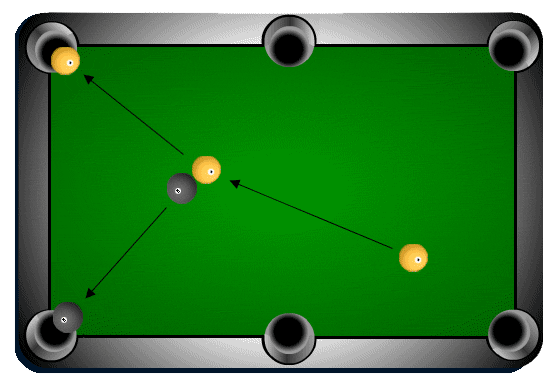
serve in which the black ball is launched into one corner pocket, and the
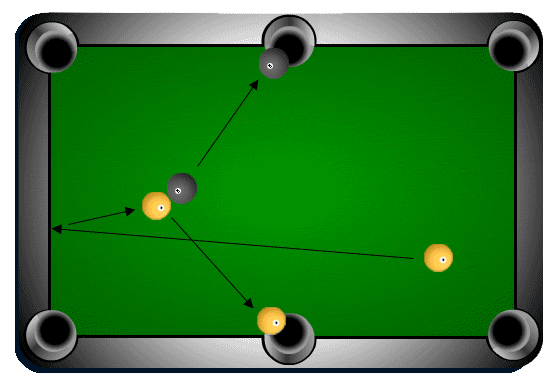
orange ball is deflected into the other (see the diagram). I’ve yet to
calculate the proper attack angle, so for now the only way to learn is practice. Yarfing alone will not win a game of two-ball, however, as one must have received a strike himself in order to serve a yarf.

Jersey Yarf
The Jersey yarf is a close cousin to the regular yarf, only the orange ball
hits the other side of the black ball. Therefore, the angle of the orange
ball’s path is much larger, as seen in the following diagram:
Reverse Yarf
A reverse yarf is perhaps the only thing flashier than a regular yarf. It’s a
serve in which the orange ball bounces against the back of the table, and
returns to hit the black ball such that both go into opposite center pockets (see the diagram).
Traveling Yarf
It’s also possible to create a yarfing pattern while the balls are in play, but
it’s hard to replicate and therefore hardly counts as a strategy.
The Belias Method
Because this technique is so characteristic of Ben Elias, I’ve gone ahead and named it after him. Most of Ben’s playing strategy consists of very
deliberately robbing his opponent of time. His shots are very slow and
calculated ones intended to slow or even stop the black ball, while leaving
both balls inconveniently on the same end of the table. Playing by this
strategy is the only known instance in which speed is not advantageous in
two-ball.
Tournament Play
For now, the only form of tournament play is one-on-one, with a traditional
bracketing system. A multiplayer tournament format, however, is in the
works and will be revealed as soon as Sunger and I figure it out. Check back later!
Words of Warning
Yes, it is very possible to injure yourself playing two-ball. In fact, it is very
likely that after each game you will have at the very least accumulated a
number of bruises on your thighs from inadvertently running into the table.
I will not be responsible for any injuries, pain, and suffering that may result
from your games of two-ball.
It is also very possible to injure pool tables by playing two-ball on them.
Therefore, I will now set down the final rule of two-ball: one does not play
two-ball on nice tables. Apparently, it’s because repeated high-velocity
impacts will eventually break the backs of the pockets. I’m not sure I
believe this explanation, since it seems that this would eventually happen in ordinary pool also. If anyone has any other thoughts on the matter, please let me know. For the time being, forget reason and call it etiquette. I will simply leave it as a mythic truth that for this reason one plays two-ball in Wu Basement but emphatically not in the billiards room at Campus.
10. Other Traditions
- Banana Halftime: Halfway through rehearsal, we eat bananas
- Bandquet: End of calendar year banquet where new officers are announced, DMs give awards, and everyone dresses tacky formal. This is a whole day celebration, so make sure to clear your calendar for the day
- Binner: We eat dinner together at 6 before rehearsal. This usually takes place in the ROMA PDR, but keep an eye out for the #social channel for confirmation
- Garb (aka trash percussion): Basically anything that is not a proper instrument, such as the Santa, Frosty, Wet Floor Sign, and many others
- Lobstering: When we win (add to basketball section)
- POOP: A compilation of all the questionable things band members say in a week, memes, and the schedule. Say “OOH AHH” whenever you hear one and send it to a DM for inclusion in the Poop.
- Two-ball:
- Verbatums: Report silly things other bandies say to the Discord
- White Castle: During reunions, there is an eating challenge. The winner is Queen/King/Royal of the Castle for the next year.
- At the end of rehearsal, we yell HOAGIES for the Head Manager’s announcements, SHOW for the Drum Major’s, GET _______ ARRESTED for the President’s, and LAME for the DMs’
- We love the Brown Band and often play with them after games.
- After we play “The Star Spangled Banner” we raise our hats and say “Let’s gooo, Tigers!.” A “Surprise Banner” is when the band is suddenly asked to play the SSB without warning. It originates from a time when this happened and it went very poorly.
 Princeton University Band